
What Are the Benefits of Using a Nitrogen Generator?
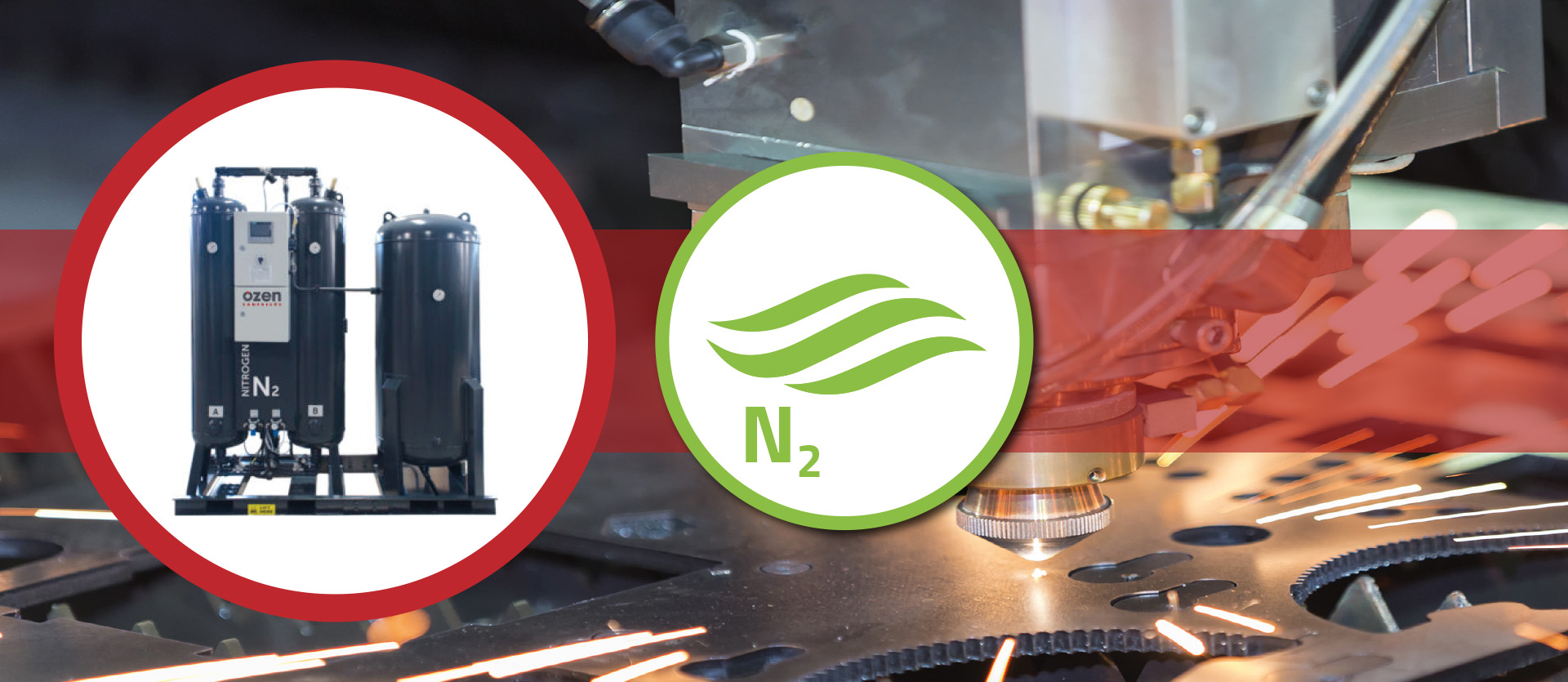
PSA Nitrogen Generators: A Detailed Review from an Engineering Perspective
1- What is PSA? Basic Principle
PSA (Pressure Swing Adsorption) is a solid adsorbent–based gas separation technology used to separate nitrogen (N₂) from oxygen (O₂) and other gases in compressed air.
- During pressurization: The adsorbent (typically Carbon Molecular Sieve – CMS) adsorbs oxygen and a portion of CO₂ / H₂O, while nitrogen-enriched gas passes to the product side.
- During depressurization: The adsorbed O₂, CO₂, and H₂O are released from the adsorbent, allowing the column to regenerate.
These two phases are typically operated cyclically between two or more columns, enabling continuous 24/7 nitrogen production.
2- Adsorbent Used: CMS (Carbon Molecular Sieve)
The core of PSA nitrogen generators consists of columns filled with CMS material.
- CMS consists of carbon granules with a specific pore size distribution and high surface area.
- Due to its pore size and surface chemistry, O₂ molecules are adsorbed faster than N₂ molecules.
- When air enters the column, O₂ is retained on the CMS bed, while N₂ progresses further and exits through the product outlet.
Critical design parameters include:
- CMS bulk density and bed height
- Bed Speed Factor (BSF): Nm³/h of N₂ produced per kg of CMS
Breakthrough time: The point at which O₂ concentration begins to increase at the bed outlet.
3- PSA Cycle: Step-by-Step Process
A typical two-column PSA nitrogen generator cycle consists of the following main stages:
- Pressurization
- The column starts at low pressure from the previous cycle.
- Compressed air is introduced to raise the pressure to operating level (e.g., 7 bar(g)).
- The product valve remains closed during this phase.
- Adsorption / Production
- The column operates at adsorption pressure.
- Dry compressed air enters; CMS adsorbs O₂, and nitrogen-enriched gas is extracted from the product outlet.
- The gas sent to the product tank is controlled according to the desired purity (typically 95%–99.999%).
- Pressure Equalization
- Gas is transferred between the high-pressure column and the low-pressure regenerated column.
- The objective is energy savings and efficiency improvement by recovering part of the pressure and nitrogen.
- Depressurization / Blowdown
- The column pressure is reduced to atmospheric or low-pressure level.
- As pressure drops, O₂, CO₂, and water vapor desorb from the CMS.
- Purge
- A small amount of high-purity N₂ flows counter-currently through the column at low pressure.
- This step removes residual O₂ and prepares the bed for the next cycle.
These steps operate alternately between columns: while one produces nitrogen, the other regenerates—ensuring continuous N₂ supply.
4- Key Design Parameters
4.1. Inlet Air
- Pressure: Typically 7–10 bar(g)
- Temperature: 5–40 °C (bed performance is temperature-sensitive)
- Air quality: Generally ISO 8573-1 Class 1.4.1 or better; oil, water, and particulates must be strictly controlled.
Therefore, a typical PSA system includes upstream:
- Screw compressor
- Refrigerated or desiccant dryer
- Coalescing and particulate filters
- Activated carbon filter for oil vapor removal
4.2. Pressure and Purity
- Higher adsorption pressure increases O₂ adsorption capacity → smaller beds for the same purity or higher purity with the same bed size.
- There is a typical trade-off between purity, efficiency, and energy consumption:
- As purity increases (e.g., 99.9% → 99.999%):
- Required air flow increases,
- N₂ recovery decreases,
- Compressor energy consumption rises.
- As purity increases (e.g., 99.9% → 99.999%):
Design is usually optimized according to process requirements (e.g., 99.95–99.999% for laser cutting; 99.5–99.9% for food applications).
4.3. Cycle Time
- Total cycle time per column typically ranges from 60–180 seconds.
- Too short cycles → insufficient contact time, reduced purity.
- Too long cycles → CMS saturation and breakthrough risk, requiring larger beds.
4.4. Capacity Calculation (Conceptual)
In simplified terms:
- Target N₂ flow rate (Nm³/h) and purity are defined.
- Required air flow is determined from CMS data or empirical correlations.
- Column volume and diameter are calculated based on cycle time and BSF.
- Inlet/outlet tanks, piping, valves, and control systems are then sized accordingly.
5- PSA Nitrogen Generator System Components
A typical PSA nitrogen generation system includes:
- Compressor (usually oil-injected screw type)
- Air pre-treatment system
- Refrigerated or desiccant dryer
- Filters (coalescing, particulate, activated carbon)
- Air receiver tank (buffer)
- PSA unit
- Two or more CMS-filled adsorption columns
- Automatic pneumatic or electric valves
- Piping, silencers, exhaust lines
- Nitrogen product tank
- Control and automation system
- PLC, HMI, pressure sensors
- O₂ analyzer, flow meter
- Remote monitoring options (Ethernet/Modbus, etc.)
6- Advantages of PSA Nitrogen Generators
- On-site generation
- Eliminates dependence on cylinder or bulk nitrogen supply.
- No logistics, rental, or boil-off losses.
- Low operating cost
- Main operating cost is electricity (compressor and auxiliaries).
- In medium to long term, PSA is often more economical than liquid nitrogen for high consumption sites.
- Flexibility
- Purity and flow rate can be adjusted via the control system (within limits).
- Future capacity expansion is possible by adding modules.
- Safety
- Reduced need for high-pressure cylinder storage.
- Lower operational risk compared to liquid nitrogen tanks and tanker deliveries.
- Environmental benefits
- Reduced tanker transportation → lower CO₂ emissions.
Cylinder and pallet logistics are completely eliminated.
7- Application Areas
- Laser cutting and welding
- Heat treatment and metallurgy (furnace atmospheres, nitriding, protective atmospheres)
- Food and beverage (MAP packaging, inerting, tank blanketing)
- Chemical and petrochemical (reactor inerting, pipeline purging)
- Electronics, semiconductors, and lithium-ion battery manufacturing
- Oil & gas (pipeline drying, pigging operations)
- Pharmaceutical and biotechnology
8- Maintenance, Operation, and Typical Failures
8.1. Routine Maintenance
- Periodic replacement of filter elements
- Dryer maintenance and consumables
- Valve, sensor, and instrumentation checks
- O₂ analyzer calibration
- Periodic CMS bed performance checks (breakthrough testing)
8.2. Typical Root Causes of Problems
- Insufficient air quality → CMS contamination by oil or moisture
- Excessive or irregular load changes → purity fluctuations
- Incorrect pressure/flow control settings → capacity or purity issues
- Improper tank sizing → frequent start/stop cycles and pressure instability
9- PSA Nitrogen Generators vs. Alternative Solutions
| Solution | Advantages | Disadvantages / Limitations |
| Cylinders | Low initial investment, ready infrastructure | High unit gas cost, logistics, safety, inventory |
| Liquid nitrogen | Low unit cost at high flow rates, very high purity | Tanker logistics, storage tanks, boil-off losses |
| PSA N₂ | Low OPEX for medium–high demand, 24/7 on-site production | Initial CAPEX, dependence on air quality and energy |
| Membrane N₂ | Compact, simple, low maintenance | Efficiency drops at high purity (>99.5%), limited O₂ control |
10- Key Questions to Ask During the Purchasing Process
- What are my process nitrogen flow rate and purity requirements (Nm³/h and %)?
- What are the peak and average consumption levels?
- Is my existing compressor infrastructure sufficient for PSA operation?
- Considering energy costs, what is the expected ROI (return on investment)?
- Which standards and certifications are required (CE, PED, ASME, ISO, etc.)?
- How will service and spare parts support be provided (local service, remote monitoring)?
Providing clear answers to these questions is the key to a correctly sized and sustainable PSA nitrogen generator investment.